Wires, Weights & Happy Accidents: Andy Bell and Timothy Clerkin Go Head-to-Head

Andy Bell (GLOK) and Timothy Clerkin talk analogue warmth, happy accidents and the art of the remix.
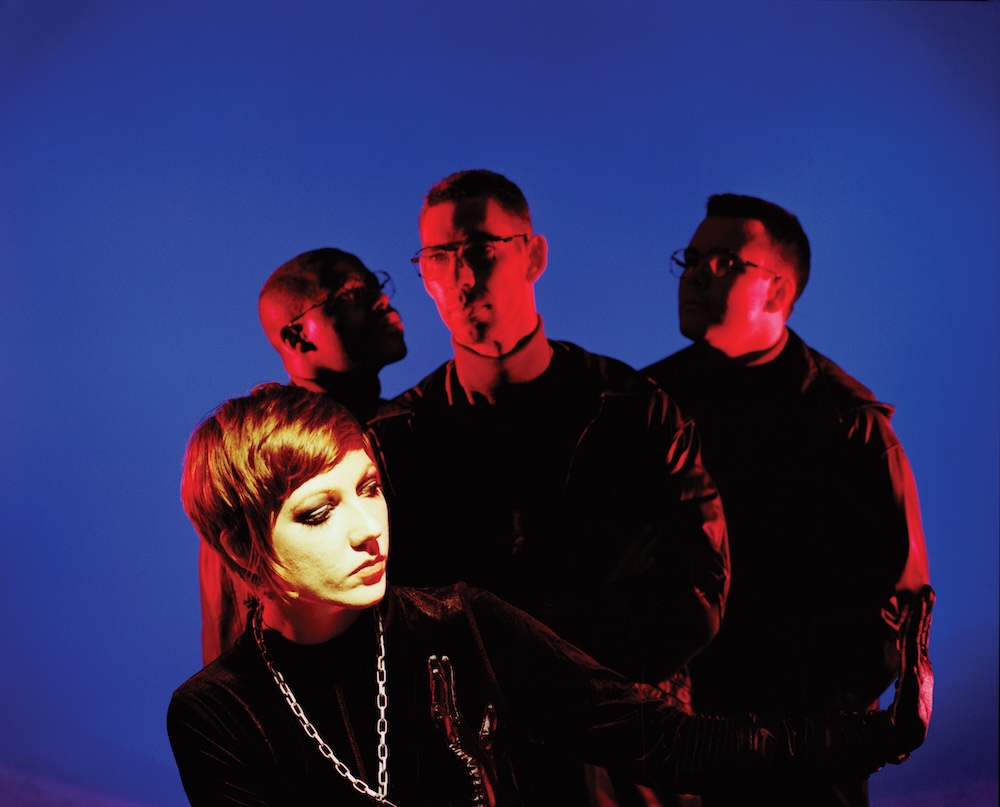
The name GLOK is the German word for “bell”, deliberately misspelt. It’s a small detail that tells you something about how Andy Bell approaches his electronic work: close enough to the source to be rooted, but slightly off-grid by design. Best known as the guitarist and co-founder of Ride, Bell has spent the better part of a decade building a parallel life in the studio under the GLOK alias, releasing records on the Bytes imprint run by Joe Clay and myself. His music as GLOK sits somewhere between kosmische, techno and shoegaze, without settling in any one place for too long.

Alliance, the 2024 collaboration with the producer and Insult to Injury label boss (our very own) Timothy Clerkin, reached No 3 on the album dance charts. Alliance Remixed, released in February this year, featured a roster that says a lot about where the record landed – bdrmm, Yu Su, Legowelt, Richard Sen, Tom Sharkett, Xylitol and FROID DUB, each pulling at a different thread.
The two collaborators interviewed each other for R$N and talked about analogue brute force, digital tidying up, Steve Reich as rhythm generator, the best remix either of them has ever heard and shoes.
Alliance Remixed, the reworking of their 2024 collaboration, is out now on Bytes
Timothy Clerkin questions, Andy Bell answers
Your GLOK output has a distinctly analogue warmth. From my experience working with you, I know how hands-on you are. How do you describe the balance between hardware and software to people who haven’t seen you work?
I go back and forth between analogue and digital all the time. Recording hi-hats would be a good example. I have a Roland 606 drum machine (my favourite drum machine), and the usable tempo range is in such a small part of the dial that you just can’t match it to a bpm and make it stay synced for the whole track. The easy thing to do would be to pull up a software version of a 606 and type in the parts into the grid on screen. But there’s something about drum programming that is so much better when you’re hands-on with a machine. I want the best of both worlds: a real 606 but bang on the grid, and the process of getting this to happen leads to an even better result due to the mix of digital and analogue. I’ll get something running on the 606, pretty close in tempo, and then do a live take for the whole track. When that’s recorded, it’s obviously getting more and more out of time as the track carries on, but I’ll use Flex Time in Logic to quantise it into 16ths, which is basically like violently ironing it out so that every sound happens on a beat that sounds right. It squishes individual hihat sounds back and forth inside the grid from where they were, creating these amazing patterns that are so much better than what I would have done if I’d been perfectly synced. The more the recording has slid away from the tempo, the more extreme things happen. I did exactly that with the hats on ‘Closer’ and ‘Dirty Hugs’, for example. That’s a snapshot of how I use digital and analogue together.
My recording setup is quite lo-fi. I prioritise feeling over sound quality, but it all ends up in Logic, which is how you can tame it. Modular is dirty, noisy, out of tune, and out of time, but you can use that to your advantage if you keep it musical. Ears do a lot of the work. They are quite forgiving about things being in tune or in time: in small doses, things being out of tune with each other can register as fatness. Having two oscillators tuned to the same note on a synth, as you tune one away from the other, you can hear fatness, then it starts beating like a binaural modulation, and finally it will start to sound properly ugly, and that’s when you’ve left the range where hearing is on your side. There’s a similar thing with timing: things being slightly out of time can be registered as human feeling. If you want to hear what the brain forgives or even invents with timing, listen to Steve Reich’s Piano Phase and how, as it shifts, you hear all these great rhythms which a pianist could never have performed.
I love using generative arpeggiators to make basslines. I’ll set one up to sequence in an ongoing Brownian mode, kind of half random but within certain parameters, and with the parameters of the root note you’ve set the oscillator to. I use a module called Arpitect, which allows you to set musical scales to choose notes from and keeps the random elements musical. So this thing is generating while I play with the low-pass filter and resonance controls, and then it’s done. There’s a process of finding good four-bar chunks, which I slot into the track and hear as basslines or synth hooks. Up to this point, the whole process has been analogue, but in Logic I’m again slicing things up, quantising, and arranging on screen. So it’s a good mix of the best of both worlds, all the time.
We’ve talked a lot about the overlap between shoegaze and techno. Do you think listeners who come from a Ride background get what you’re doing with GLOK, or does it go over their heads?
I am pretty sure that most GLOK fans are already Ride fans. But that’s not to say that they only like GLOK because it’s me. I think there’s a lot in common between listeners of electronic and shoegaze music, and it’s natural for people who appreciate one to appreciate the other. I do look forward to meeting someone who tells me they got into Ride via being a GLOK fan.
Who were the DJs or producers that first made you realise electronic music could hit you as hard as a band at full volume? Was there a single moment that cracked it open for you?
Mr Fingers and A Guy Called Gerald were music I heard in my late teens that struck a chord. I loved it in the mid to late 80s, when rare groove was a thing and people were sampling a lot of dirty 70s funk into dance and hip-hop records. I was into all kinds of music at that age. It was the fact that I was already a guitarist that prompted me to make guitar music and form a band. I can imagine a situation where, if I’d been given an MPC or a sampler, I would have ended up going down a different route. But since I was nine, I’d been obsessed with guitar, and there was no other way it was going to go.
When you come into the studio to work on GLOK material, do you bring references, or do you prefer to just see what the machines suggest on the day?
Yeah, it’s very much a case of seeing what happens.
Is there a tempo or BPM that feels like home to you when you’re making music as GLOK? I think I have a sense of the answer, but I want to hear you say it.
Ha, well, the upper limit is around 118bpm. That, for me, is my version of gabba or something. I am very happy, even down in the 70s; in fact, most of my recent remixes have been very slow. But my most favoured territory is from 90 up to 108bpm.
Working together, I noticed you keep your guitar world and your electronic world pretty separate. Is that a conscious thing, or does it just naturally stay that way?
That’s not so much the case at the moment. Everything is currently in one big mess altogether.
What’s your shoe size?
9/43.
What is your most prized 12″?
A few from the 80s and 90s: A Guy Called Gerald’s ‘Voodoo Ray’, ‘Temptation’ by New Order, ‘Blue Monday’ by New Order.
Do you think vinyl will continue to be popular with new generations, or is it eventually doomed?
It’s not very environmentally friendly, which is depressing. I think it will always remain popular with a certain breed.
How do your early guitar band influences present themselves in your electronic output?
I find the palette of guitar and bass sounds running through post-punk into shoegaze works incredibly well with electronic music.
What are some of your favourite remixes by other artists?
Present company excepted!
Ricardo Villalobos – African Man by Tony Allen
Underworld – ‘Human Behaviour’ by Bjork
Andrew Weatherall – ‘Come Together’ by Primal Scream
A Guy Called Gerald – ‘Fools Gold’ by The Stone Roses
Erol Alkan / Richard Norris – ‘Roscoe’ by Midlake
David Holmes – ‘Smokebelch II’ by Sabres of Paradise
Frankie Knuckles – ‘Ain’t Nobody (Hallucinogenic Version)’ by Chaka Khan
What makes a good remix?
It should have at its core many elements of the original, but still have its own reason for existing.
What do you think is the best remix you have done so far?
Dot Allison – ‘Unchanged’
Hermann Kristofferson – ‘Gone Gold’
Justin Robertson – as yet unreleased! (Coming soon)

Andy Bell questions, Timothy Clerkin answers.
What are the ingredients of a good day’s work?
Being productive without being stressed is key. Deadlines are good (I’d never get anything finished without them), but as long as you’re making progress towards a goal with artistic merit, a good day’s work has been had. It doesn’t need to be linear progress either: two steps back can sometimes be a good thing for creativity. There has to be time dedicated to mucking about in the studio without any pressure to write the next ‘Bohemian Rhapsody’ or anything. And taking time for lunch, coffee and meditation, if that’s your bag.
Has imposter syndrome ever figured, and how have you overcome it?
Yeah, I definitely used to overcompensate in a lot of ways as a younger musician. I kind of got forced to be a DJ by my old manager (he was totally right, doing electronic music as solely a live act was a ridiculous idea), so there were lots of imposter-type feelings around that. I used to have anxiety dreams about forgetting how to mix. But, as with most things, I just kind of grew out of it. The marvellous thing about getting older is realising what matters and what really doesn’t.
Are you a morning person?
My six-month-old daughter ensures that I am, yes. I’d love to see if I’m still capable of sleeping past 6am at some point, but I go to bed at 9:30pm every day, so that seems decadent. Until then, strong black coffee and a cold shower see me through.
Favourite mono synth?
Impossible to answer. But I love my MS-20: where would modern electronic music be without that? The Minimoog as well, I use it a lot on everything, probably more versatile than the MS-20. But my love affair with the 2600 is showing no signs of slowing down either, so I cannot choose. My SH-101 is probably my most-used mono synth.
Eurorack fan or no?
Absolutely a fan. I love people bringing round their modular rigs to collaborate, and I love playing on them, but I don’t have any of my own in the studio. They take up too much tinkering time. I procrastinate enough without the endless possibilities of triggering this module from the gate out of that one. I’d never make any music. The vast majority of my synths have keys attached to them, so I can immediately get ideas down and not overthink the whole process.
Which guitar looks the coolest?
Andy with a Trini Lopez is a great answer. I have always wanted one, but as a lefty, they are very hard to come by and very expensive. I have a penchant for big red semis and own more of them than I really should. But Kurt with a Jaguar, Paul with a Casino, Jimi with an upside-down Strat and Iommi with a Gibson SG were my leftist heroes.
Logic, Ableton, Pro Tools or something else?
Logic, Pro Tools and Ableton. They all have different specialities and are useful for different things. I know people get very attached to their DAW and become quite preachy. These people need to get a grip and concede that all DAWs are inherently terrible because analogue is far, far superior to digital and always will be.
What’s your process when you’re asked to remix a track?
I usually chuck everything into Ableton so I can mess around with the pitch and timing a fair bit first, then, as it’s beginning to take shape, put the stems in Logic or Pro Tools to record all the other elements. I aim to make my remixes a different genre from the original, whilst using as many of the original stems as possible.
What are some of your favourite remixes by other artists?
I heard Erol doing a 00s mix on the radio the other day, and it reminded me how much I love that Justice remix of Franz Ferdinand. That was one of the things that made me want to start making club music. The Soulwax mix of ‘Gravity’s Rainbow’, as well, is definitely a big influence and one of the reasons I bought a 2600. That Yu Su remix of ‘Scattered’ by Andy and me is currently on heavy rotation: what an absolute gem. Some all-time favourites are the AFX mix of 808 State, the UNKLE mix of Queens of the Stone Age and the Two Lone Swordsmen remix of Spiritualized. Fifteen minutes, and it could easily be longer.
What makes a good remix?
A new musical direction, bringing out parts of the original that were buried in the mix and, if I’m really honest, a great big catchy melodic hook.
What do you think is the best remix you’ve done so far?
My remix of Projected Sounds by GLOK. And that one I did for Graintable. A Throbbing Gristle remix I did as one half of Eskimo Twins many moons ago seems to be having a slight renaissance, inexplicably.
‘Alliance Remixed’ is out now on Bytes











Must Reads
David Holmes – Humanity As An Act Of Resistance in three chapters
As a nation, the Irish have always had a profound relationship with the people of Palestine
Rotterdam – A City which Bounces Back
The Dutch city is in a state of constant revival
Going Remote.
Home swapping as a lifestyle choice
Trending track
Vels d’Èter
Glass Isle
Shop NowDreaming
Timothy Clerkin
Shop Now