Track By Track: The Interstellar Music of Martin Glass

2025 sounds futuristic, doesn’t it? In a way, it is. Pop stars and self-styled billionaire superheroes shoot themselves into space. Rockets land automatically, as if filmed in reverse. The James Webb Telescope observes our position in the cosmos with startling clarity.
Even our early, primitive efforts to explore the universe continue to bear fruit. The Voyager 1 and Voyager 2 space probes were launched by NASA in 1977, conducting pioneering imaging of our solar system.

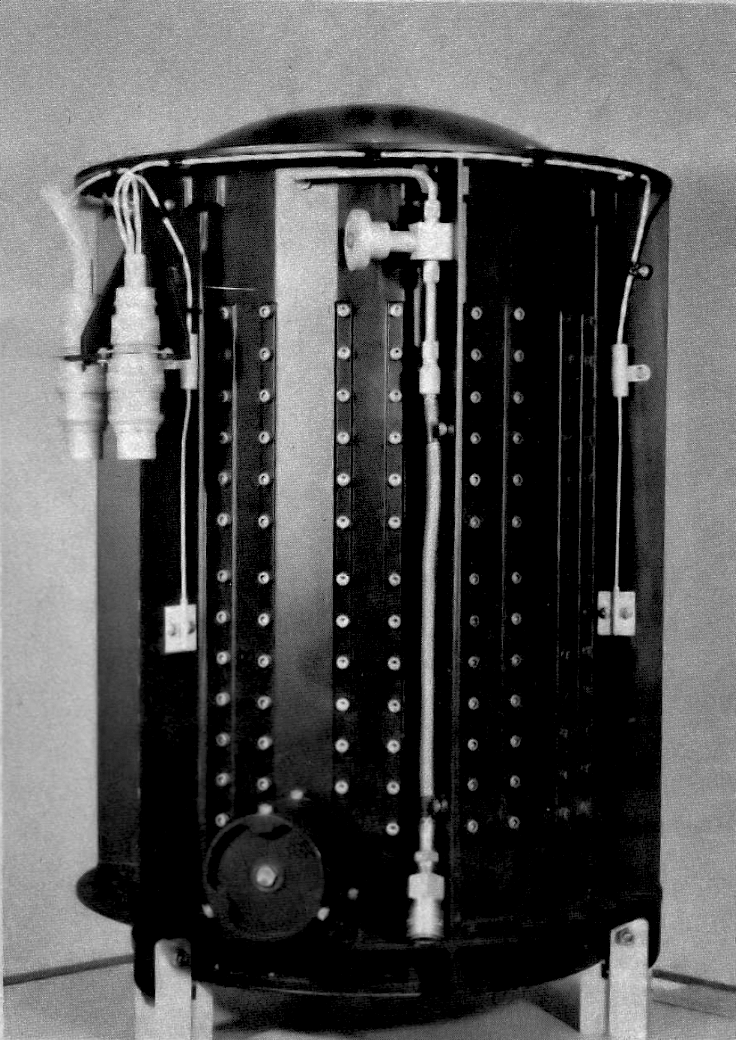
As of February 2025, Voyager 1 has cruised a distance of 25 billion km into space, making it the most distant human-made object from Earth. Despite having crossed the boundary into interstellar space, these small crafts continue to return data to their command centre.
In a project disowned by NASA, sound artist and synth guru Martin Glass was originally commissioned to document Voyager 1’s journey, using images and data from the craft’s camera and other instruments. Even after funding for the project dried up, Martin’s growing series of audio “sonologues” charted the craft’s material progress, and its imagined psychogeography.
The very best of these scores, chosen from a vast compendium of source material, have been assembled for the first time by London label Kit Records. Below are some picks from “The Interstellar Music of Martin Glass“, together with the images and data that inspired them.
1. Crossing the Heliopause
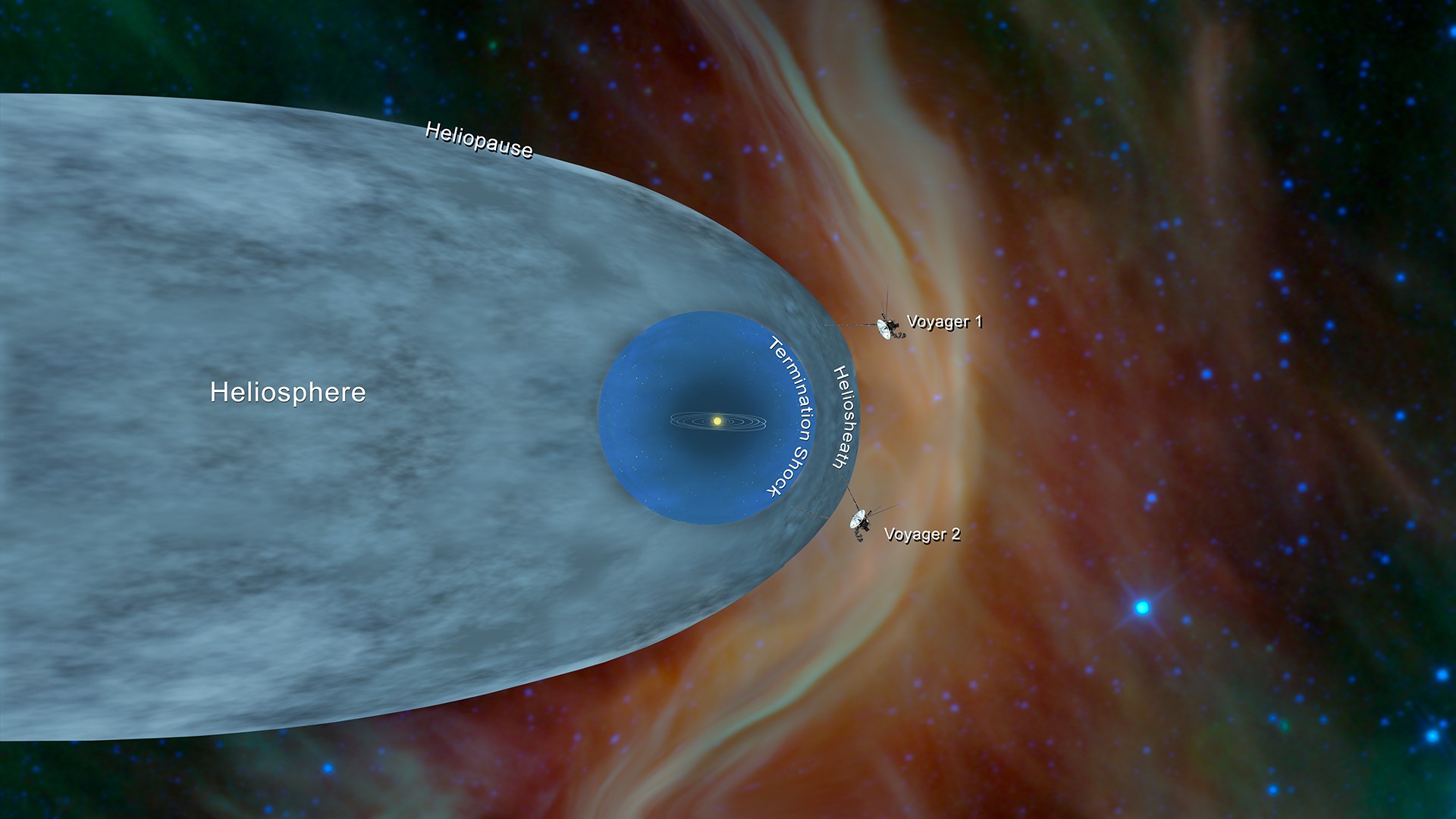
Voyager 1 crossed the heliopause, the boundary where the Sun’s influence transitions into interstellar space, providing valuable data on the interaction between the solar wind and the interstellar medium
The heliopause is the boundary where the Sun’s influence, specifically the solar wind and magnetic field, ends and the interstellar medium begins. Voyager 1 crossed the heliopause on August 25, 2012, and Voyager 2 followed suit on November 5, 2018. These events marked the first time human-made objects entered interstellar space
The heliopause is the outermost boundary of the heliosphere, a bubble-like region of space, where the solar wind and the interstellar medium meet.
2. Saturn’s Hexagon Storm
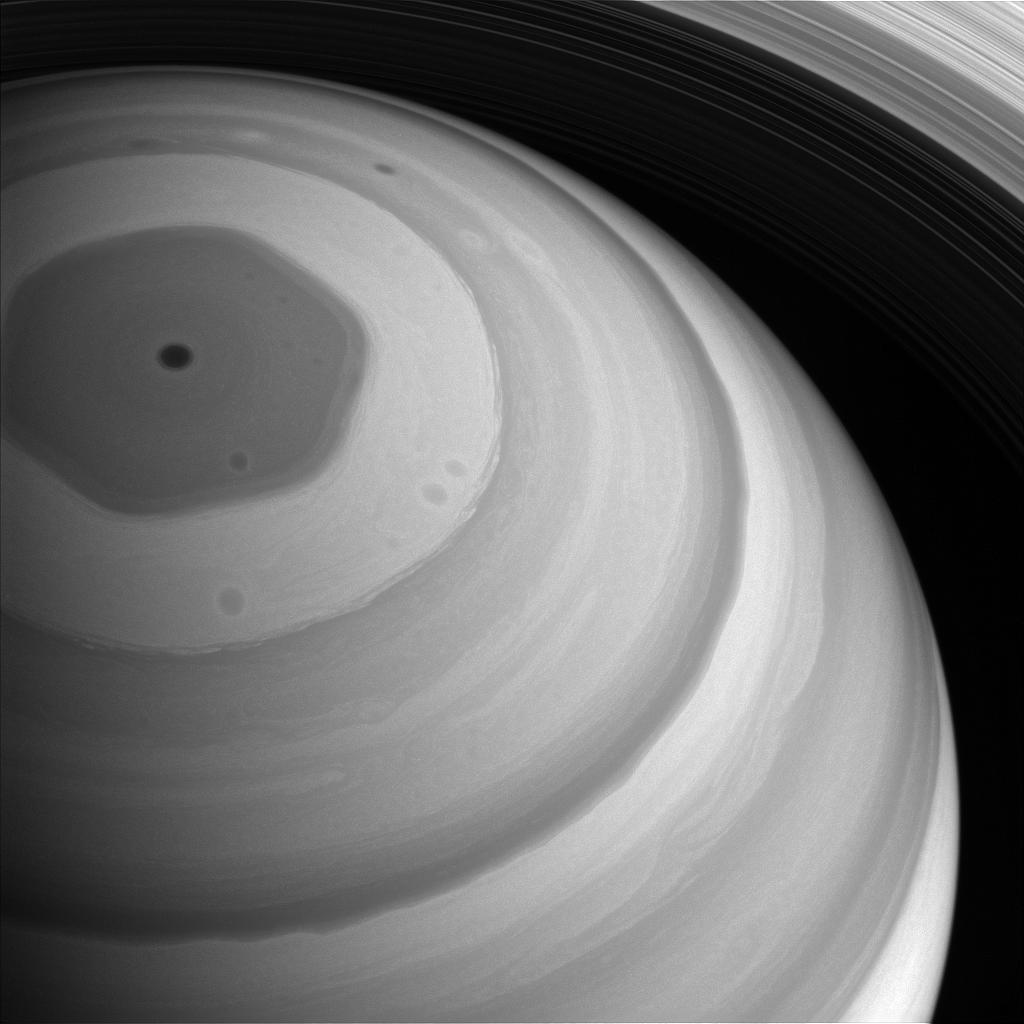
In 1981, Voyager 1 captured images of Saturn’s North Pole that left the scientific community astounded. It took a few years for scientists to refine the images, but they eventually revealed a strikingly perfect hexagonal pattern on the ringed planet.
Following the first discovery, the hexagon remained hidden in darkness until sunlight exposed the six-sided shape again. The Cassini spacecraft then provided a series of captivating images and even produced a video of the hexagonal weather pattern. While Cassini had studied the shape in infrared during its period of darkness, the sunlight allowed for clearer, more detailed observations.
The hexagonal storm on Saturn is colossal in size. Its sides are longer than Earth, and it has an estimated depth of around 180 miles. The eye of the storm is 50 times larger than a typical Earth storm. Over the years, Cassini’s colour images have shown the storm changing from blue to gold.
Winds of ammonia and hydrogen surround the storm, moving at speeds higher than 300 miles per hour. Several vortices (storm centres) have been observed within the hexagon, some moving clockwise and others counter-clockwise. The largest vortex, which appears white, is about twice the size of a standard hurricane on Earth.
The hexagon itself is a jet stream comprised of atmospheric gases, which scientists have referred to as “just a current of air and weather features.” Another intriguing aspect of the hexagon is that the vortex is situated at a higher altitude than Saturn’s clouds, making the shape appear like a towering structure. The planet’s aurora, caused by its magnetic field, sits atop the hexagon, giving it the appearance of a fiery hexagonal shape.
3. Jovian adventure – Looking back at Jupiter, ‘seeing the ring’
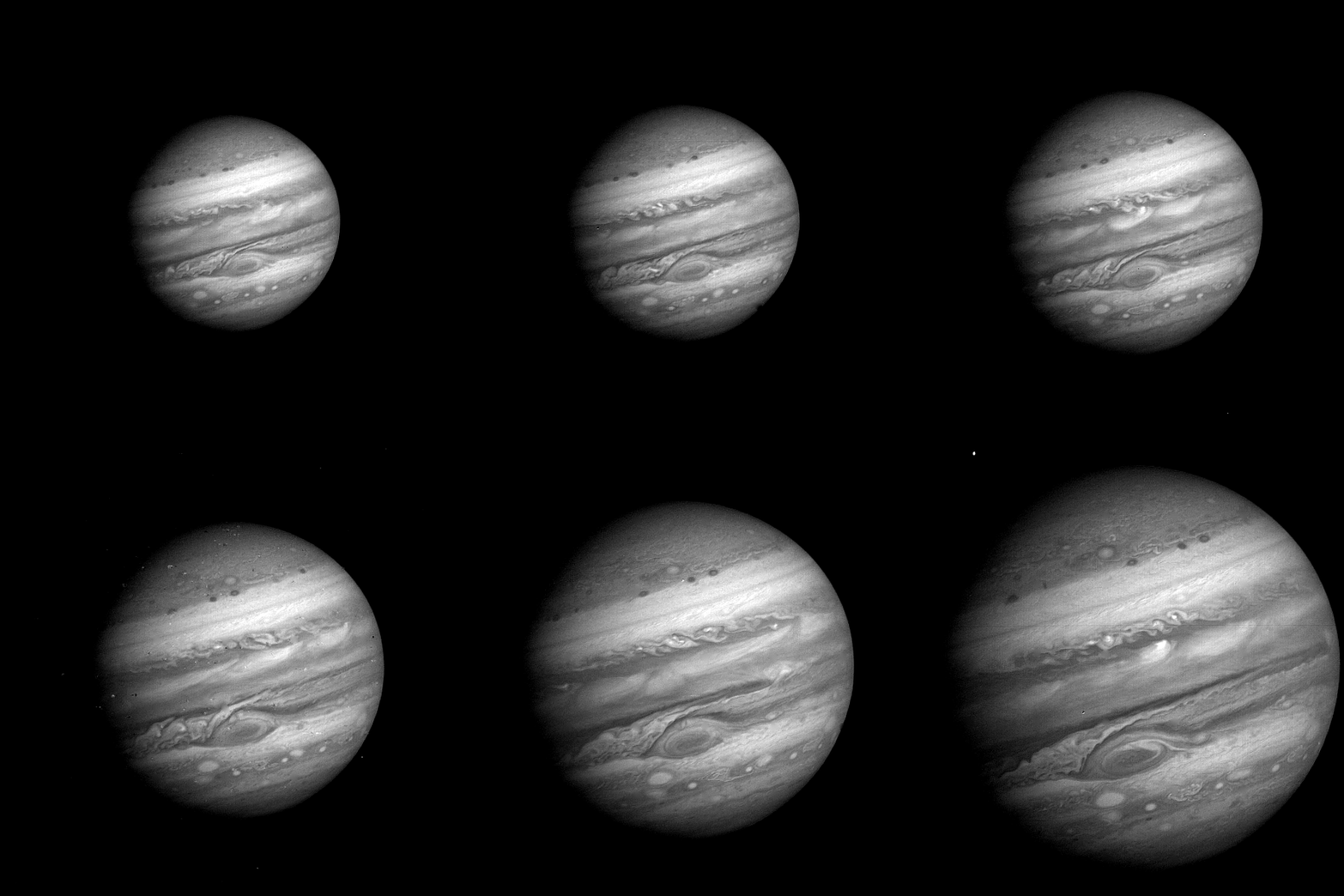
The spacecraft began its encounter phase with the Jovian system on January 6, 1979, sending back its first images and taking the first scientific measurements. On March 5, still inbound toward the planet, it flew within 262,000 miles of Jupiter’s small inner moon Amalthea, taking the first close-up photographs of that satellite, revealing it to be oblong in shape and reddish in colour.
About five hours later, Voyager 1 made its closest approach to Jupiter, flying within 174,000 miles of the planet’s cloud tops. On the outbound leg of its encounter, it flew by and imaged the large satellites Io (closest approach of 12,800 miles), Europa (456,000 miles), Ganymede (71,300 miles), and Callisto (78,600 miles), all discovered by Italian astronomer Galileo in 1610 using his newly invented telescope.
The Voyager images revealed each satellite to have a unique appearance, the most remarkable discovery being an active volcano on Io. Voyager 1 also discovered two previously unknown moons orbiting Jupiter, later named Thebe and Metis. Looking back at Jupiter as it was backlit by the Sun, Voyager 1 discovered that the planet is surrounded by a thin ring. Observations of Jupiter concluded on April 13.
4. Crossing the Kuiper belt
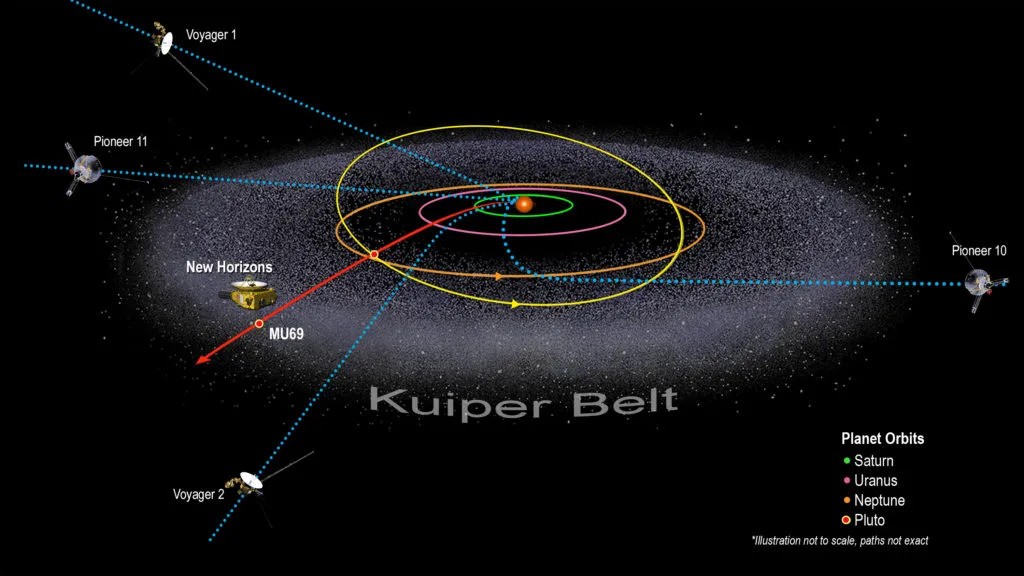
The Voyager 1 and Voyager 2 spacecraft have both crossed the Kuiper Belt. Voyager 1 was already past the Kuiper Belt by the time it was discovered in 1992, and Voyager 2 was deep within it, according to a blog post on the NASA website. While not specifically designed to explore the Kuiper Belt, the Voyagers’ instruments collected valuable data about the region, contributing to our understanding of the Sun’s heliosphere and the Kuiper Belt’s plasma environment
The Kuiper Belt is a vast, donut-shaped region of icy bodies located beyond Neptune’s orbit. It is home to Pluto and most other known dwarf planets, along with countless smaller objects and some comets. Essentially, it’s a “leftover” from the solar system’s formation, containing remnants that never fully coalesced into planets.
5. Touching the Empyrean
From the Primum Mobile, Dante ascends to a region beyond physical existence, the Empyrean, which is the abode of God. Beatrice, representing theology, is here transformed to be more beautiful than ever before. Her beauty echoes the tradition of courtly lyric, which also pertains to her courtly role in the narrative that revolves around helping Dante and purifying him so he can ascend. Dante becomes enveloped in light, first blinding him and then rendering him fit to see God.
The whole cosmos, according to Dante, ultimately depends on God who, as the ground of all being, exists beyond space and time in the Empyrean. The Empyrean is an immaterial heaven, made up only of the love and metaphysical light which God is. It is in the Empyrean that the angels and the blessed also dwell. As we shall see, however, throughout his journey Dante also meets different groups of souls in the different heavens. Dante’s understanding of the Empyrean is one of the most important parts of his idea of paradise.

6. Unknown phenomena in deep space
Voyager 1 has made a recent discovery that raises questions about our understanding of interstellar space. The probe, now far beyond the Sun’s influence, has detected unusual signals that don’t fit existing models of cosmic radiation or plasma waves. These signals, characterised by patterns and frequencies that seem to defy current scientific knowledge, have led to speculation about new phenomena, including the possibility of unknown cosmic structures or even extraterrestrial origins.
Voyager 1’s instruments have picked up signals in interstellar plasma that are unlike anything recorded before by the Voyager missions. These signals exhibit patterns and frequencies that don’t align with what scientists understand about cosmic radiation or plasma waves.
While some researchers suggest these signals might be caused by interactions between interstellar particles, others are exploring more extraordinary possibilities. These include the possibility of unknown cosmic structures or even the possibility of a new type of cosmic phenomenon.
Some reports even suggest that a quantum chip, the Majorana 1 from Microsoft, has been used to analyse Voyager 1’s data and identify signals with prime numbers, universal constants, and a 3D spiral pattern. These signals, according to some, could be interpreted as evidence of extraterrestrial intelligence or a hidden message.
Image: https://stsci-opo.org/STScI-

The Interstellar Music of Martin Glass is out now on Kit Records.
















Must Reads
David Holmes – Humanity As An Act Of Resistance in three chapters
As a nation, the Irish have always had a profound relationship with the people of Palestine
Rotterdam – A City which Bounces Back
The Dutch city is in a state of constant revival
Going Remote.
Home swapping as a lifestyle choice
Trending track
Vels d’Èter
Glass Isle
Shop NowDreaming
Timothy Clerkin
Shop Now