Track By Track: Amuleto Apotropaico – Língua Espúria
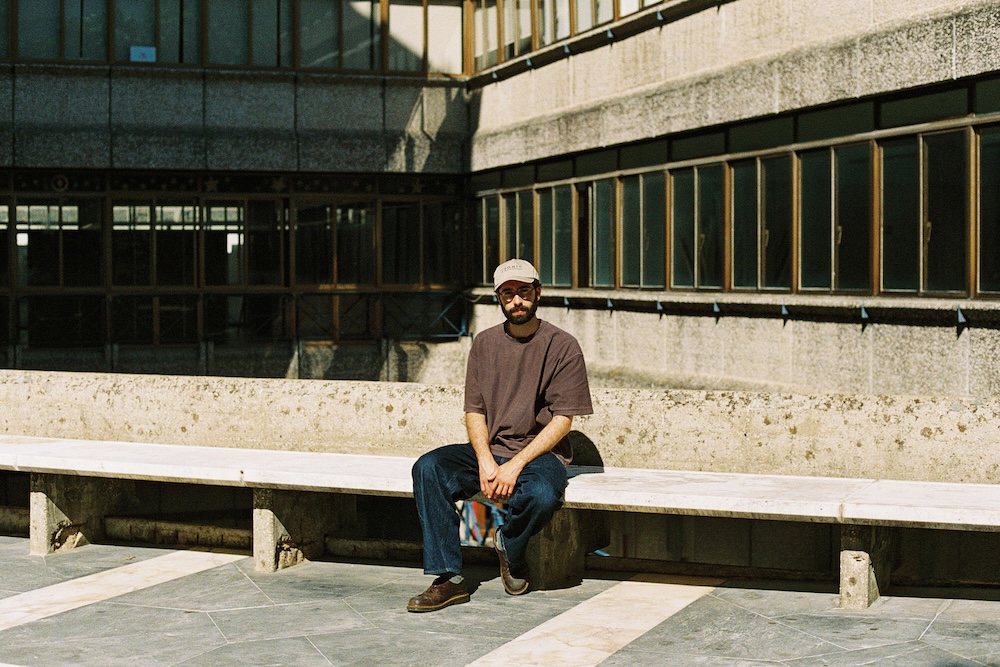
Stretching a small interval of time to infinity – Amuleto Apotropaico’s Feiteira on the percussion systems behind ‘Língua Espúria’
Amuleto Apotropaico formed in 2021 around a shared fascination with ritual, noise and repetition. Feiteira and Francisco Pedro Oliveira grew up together in Santa Maria da Feira and are now based in Porto, drawing on northern Portugal’s folklore and rhythmic traditions and imagining new rituals from old materials. Their 2025 self-titled debut, their first release on the Perf label, distils two years of live performances into four pieces built around the exchange between Feiteira’s drums and Oliveira’s guitar, flute, and electronics.

‘Língua Espúria’ (Spurious Tongue) moves away from that exchange. Feiteira steps into a fully electronic framework of fractured rhythms, concrete textures and self-generating systems, taking his cue from Milford Graves’ work translating the body’s hidden rhythms into function generators. He built a custom system that mirrors his own improvisational drumming, “sequencing algorithms that allowed me to recall specific gestures, dynamics and an organic sense of pulse variation.” Automating some aspects of the performance and hosting them in a digital framework lets him “focus on investigating timbre and space outside the realm of the physically possible.” The record stays rooted in the questions that have shaped the duo from the start: how rhythm can carry memory, how noise can become a form of ritual, and how electronic systems can preserve the unpredictability of a human performance.
Abafador
The opener, ‘Abafador’, is where the system first becomes audible. The percussion that drives its second half comes from one of those studies: “By splitting the percussion between four different chains of polyphonic resonators within each measure, there is a cascading harmony constantly folding into itself in breath-like cycles.” The full track is that pattern in context, shaped “through a build-up and breakdown.”
Once he knew what the whole album would sound like, it was clear ‘Abafador’ had to open it. He wanted its first couple of minutes to hold the whole spectrum of timbres heard across the record, “patiently unveiling these voices in spaced out sentences.” Bunita Marcus’s ‘Lecture for Jo Kondo’ was an important reference, particularly its repeating phrases that “seem to clash with the sense of inertia evoked through the piano and percussion’s long sustain.” He went after the same feeling by setting patterns against slowly modulating additive synthesis drones, “letting the unfurling of the harmonics guide the harmony without breaking the impression of stasis.”
The last element finished was the distorting pad that opens and closes the track. He felt the lack of a melodic throughline, and it only made sense once he started “blurring and eroding its outlines, a balanced counterpart to the overall clean brightness.”
Carpideira
‘Carpideira’ comes from the same percussive motif, inverted, and most of it is that source material extrapolated at different stages of a continuous resampling practice. ‘Abafador’ can be mapped through a series of spasmodic events that lead somewhere else; here, he says, “I deliberately avoided these orientation marks.” The first part was meant to sound suspended, “as if stretching a small interval of time to infinity.” He set up a couple of additive and granular synths feeding off each other’s output, opening up their variance until a breach let the resolving bass emerge. The stabs of noise and bumps of over-compressed bass arrive later as a counterpart to the stillness.
He hears variance at the extremes of the frequency spectrum as occupying an outer layer, “a deceitful modulation of the reproducing mechanism’s qualities and not so much the piece itself.” The clearest example is at the end, when the motif returns and “reversed kick drum swells trigger rough sidechain volume dips, as if they had nowhere to grow except by breaking through.”
Espinha de Vidro
‘Espinha de Vidro’ is the outlier. It is built from around eight tracks, where the others use forty to fifty, and it felt separate from the rest. Even so, he says, the album “was lacking something tangible, a clearer take on the main premise.” Almost everything comes straight from the main percussion line: chains of resonators drive the harmony, the crackling textures in the low and high end are real-time granular resampling, and the accentuations “distribute the strokes through different, deliberately incoherent spaces.” The remaining elements are kept simple, with pure tones as bass to ground the harmony and “a woodwind-like Juno pad sculpted through a series of reverbs and delays.”
Apotropia III
‘Apotropia III’ was the first track he chose for the album, and “it certainly dictates the character of the remainder of the album.” The first two Apotropia pieces were the core of the previous record, bound by a particular distribution of percussion through space and a plaintive atmosphere built around it. Once the new tools felt mature, it “just made sense to apply them within this structural framework I was already used to.”
The track also shares the narrative arc of its two predecessors: “a long, sometimes over-dramatic build-up into an ecstatic, almost epic conclusion.” It’s a trajectory he is wary of. “I actively avoid it, but there are always a couple of drafts that slip through the selection process.”











Must Reads
David Holmes – Humanity As An Act Of Resistance in three chapters
As a nation, the Irish have always had a profound relationship with the people of Palestine
Rotterdam – A City which Bounces Back
The Dutch city is in a state of constant revival
Going Remote.
Home swapping as a lifestyle choice
Trending track
Vels d’Èter
Glass Isle
Shop NowDreaming
Timothy Clerkin
Shop Now