Death Note : The Musical – A Reflection
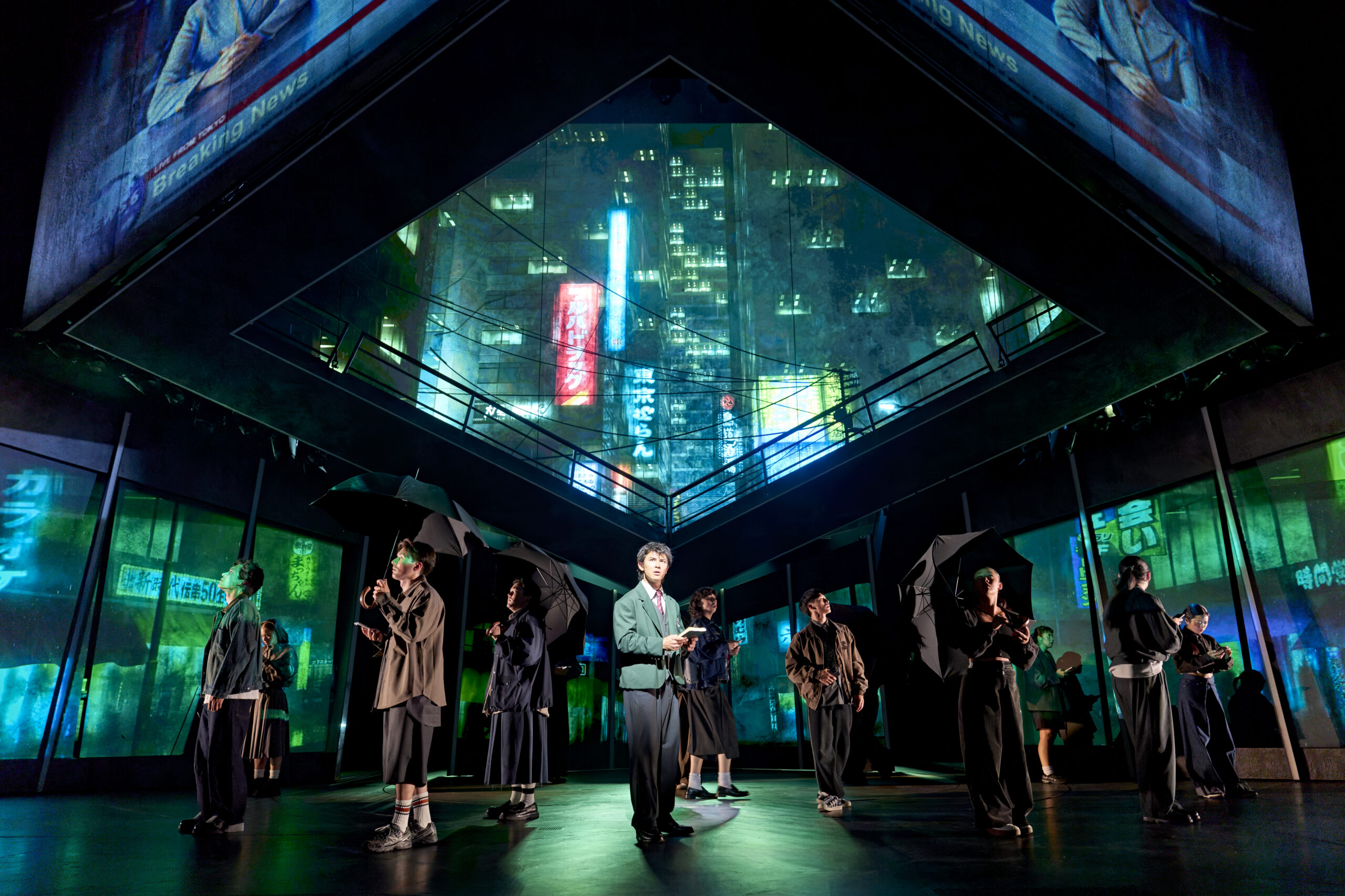
There is something wonderful in spending an evening with a couple of thousand other humans, watching a load more humans who are very skilled at singing, dancing, and conveying emotion.
Death Note started life as an incredibly popular manga series. Serialised in Japanese anthology Shonen Jump in the early 00s, it went on to sell over 30 million copies worldwide, leading to 5 spin off films, 2 spin off TV shows, a video game and several warehouses full of merch. Its twisty, gothic tale of murder and morality has been twice parodied in the Simpson’s, got banned in Beijing and caused a moral panic in Albuquerque. Is a musical the next obvious step? Why not!

For those unfamiliar with this phenomenon, the story follows Light Yagami, a star school student, as he finds a demonic notebook that allows him to see Shinagami (Japanese demons who mostly like emo Cenobites), alongside the ability to kill and control anyone whose name he writes in the book. Fuelled by a rigid notion of justice, he decides to use the book to kill off violent criminals who have evaded the law. As his murder tally rises, he is increasingly obliged to use the book to finish off the detectives who are trying to track him down. Eventually, the law enlists teenage savant ‘L’, an amateur sleuth with an uncanny ability to solve crimes. The rest of the first three volumes of Death Note plays out as an intense cat and mouse game between Light and L, reading like a Japanese rendition of classic British crime fiction – all the improbable plot twists, ludicrous deduction and dastardly behaviour of Conan Doyle or Agatha Christie spiked with supernatural horror, dumb manga humour and a splash of YA lust. Its success is down to a universally understandable moral dilemma; is retribution justifiable, and how far is too far? What would anyone do with a death note? What would you do?
Does this finely balanced moral quandary make it into the musical rendition currently showing at the Barbican. Well, kinda; delivered via the medium of rock opera belters. The Death Note manga is an intricate affair, probably over-burdened with its own complexities, but deeply rewarding in its twists and flips. A true adaptation would probably run to 12 hours with a cast of hundreds. Since this feels like a non-starter, the Barbican production has instead decided to hurtle through scenes from the book pell-mell, delivering them in a bombastic Lloyd Webber style, with Meatloaf emoting, driving drums, and twiddling rock-God guitar solos. It’s camp, it’s tacky and (r.i.p. any sense of cool I have left) it’s stupidly fun.
The set is an ingenious puzzle box of rotating stage, offices wheeling in and out, gantries rising and falling, classrooms making way for bedrooms making way for prison cells making way for stadiums, while the ensemble cast flurries in a state of constant motion. In one memorable scene, Light and L (an exceptional, twitchy comic performance from Colin Ryan) face each other down in a cyber tennis match, their movements replicated by actors playing avatars, gurning and emoting behind them like Fortnite players. The two protagonists bellow out a duet while thwacking back and forth an invisible ball, as their ‘robot’ avatars breakdance behind them. It’s chaotic sensory overload stuff – delivered with sharp, tight choreography, and for all its silliness, it’s played deadly serious.
That tightness makes the show. Everyone leans in, every song, every synchronised dance move, every soap opera emotion, delivered with absolute unblinking conviction, the kind of dedication that has seen K-Pop take over the globe. There’s no sense of irony here, just a total commitment to an idea; what if a bunch of cool scenes in Death Note were actually pop songs?
Would you have a clue what was going on if you didn’t know the story? Man, I really don’t know. Probably not? This show is really for the diehards. I felt pretty sure everyone in the theatre, with the audience ranging from teen to pensioner, was already a massive fan. Every song was greeted with whoops and joy, and the sold-out crowd ended the night on their feet for a standing ovation, delighted with their evening’s entertainment, and really, it felt great. Without wanting to bring everything I write these days back to me carping on about AI (I’m still gonna), there is something wonderful in spending an evening with a couple of thousand other humans, watching a load more humans who are very skilled at singing, dancing, and conveying emotion. Long may this continue.
For those unfamiliar with this phenomenon, the story follows Light Yagami, a star school student, as he finds a demonic notebook that allows him to see Shinagami (Japanese demons who mostly like emo Cenobites), alongside the ability to kill and control anyone whose name he writes in the book. Fuelled by a rigid notion of justice, he decides to use the book to kill off violent criminals who have evaded the law. As his murder tally rises, he is increasingly obliged to use the book to finish off the detectives who are trying to track him down. Eventually, the law enlists teenage savant ‘L’, an amateur sleuth with an uncanny ability to solve crimes. The rest of the first three volumes of Death Note plays out as an intense cat and mouse game between Light and L, reading like a Japanese rendition of classic British crime fiction – all the improbable plot twists, ludicrous deduction and dastardly behaviour of Conan Doyle or Agatha Christie spiked with supernatural horror, dumb manga humour and a splash of YA lust. Its success is down to a universally understandable moral dilemma; is retribution justifiable, and how far is too far? What would anyone do with a death note? What would you do?
Does this finely balanced moral quandary make it into the musical rendition currently showing at the Barbican. Well, kinda; delivered via the medium of rock opera belters. The Death Note manga is an intricate affair, probably over-burdened with its own complexities, but deeply rewarding in its twists and flips. A true adaptation would probably run to 12 hours with a cast of hundreds. Since this feels like a non-starter, the Barbican production has instead decided to hurtle through scenes from the book pell-mell, delivering them in a bombastic Lloyd Webber style, with Meatloaf emoting, driving drums, and twiddling rock-God guitar solos. It’s camp, it’s tacky and (r.i.p. any sense of cool I have left) it’s stupidly fun.
The set is an ingenious puzzle box of rotating stage, offices wheeling in and out, gantries rising and falling, classrooms making way for bedrooms making way for prison cells making way for stadiums, while the ensemble cast flurries in a state of constant motion. In one memorable scene, Light and L (an exceptional, twitchy comic performance from Colin Ryan) face each other down in a cyber tennis match, their movements replicated by actors playing avatars, gurning and emoting behind them like Fortnite players. The two protagonists bellow out a duet while thwacking back and forth an invisible ball, as their ‘robot’ avatars breakdance behind them. It’s chaotic sensory overload stuff – delivered with sharp, tight choreography, and for all its silliness, it’s played deadly serious.
That tightness makes the show. Everyone leans in, every song, every synchronised dance move, every soap opera emotion, delivered with absolute unblinking conviction, the kind of dedication that has seen K-Pop take over the globe. There’s no sense of irony here, just a total commitment to an idea; what if a bunch of cool scenes in Death Note were actually pop songs?
Would you have a clue what was going on if you didn’t know the story? Man, I really don’t know. Probably not? This show is really for the diehards. I felt pretty sure everyone in the theatre, with the audience ranging from teen to pensioner, was already a massive fan. Every song was greeted with whoops and joy, and the sold-out crowd ended the night on their feet for a standing ovation, delighted with their evening’s entertainment, and really, it felt great. Without wanting to bring everything I write these days back to me carping on about AI (I’m still gonna), there is something wonderful in spending an evening with a couple of thousand other humans, watching a load more humans who are very skilled at singing, dancing, and conveying emotion. Long may this continue.




Must Reads
David Holmes – Humanity As An Act Of Resistance in three chapters
As a nation, the Irish have always had a profound relationship with the people of Palestine
Rotterdam – A City which Bounces Back
The Dutch city is in a state of constant revival
Going Remote.
Home swapping as a lifestyle choice
Trending track
Vels d’Èter
Glass Isle
Shop NowDreaming
Timothy Clerkin
Shop Now